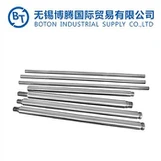
As a supplier of the 1045 Linear Shaft, I've witnessed firsthand the importance of understanding how external factors can influence the performance of this essential mechanical component. One such factor that often goes under the radar but can have a significant impact is the magnetic field. In this blog post, I'll delve into how magnetic fields affect the performance of the 1045 Linear Shaft and what you need to know to ensure optimal operation.
Understanding the 1045 Linear Shaft
Before we explore the effects of magnetic fields, let's take a moment to understand the 1045 Linear Shaft itself. The 1045 Linear Shaft is a type of precision shaft made from 1045 carbon steel. This material is known for its high strength, good machinability, and wear resistance, making it a popular choice for various linear motion applications. It is commonly used in industries such as automation, robotics, and manufacturing, where precise linear movement is required.
The Basics of Magnetic Fields
A magnetic field is a region in space where a magnetic force can be detected. It is produced by moving electric charges, such as those in a current - carrying wire or a permanent magnet. Magnetic fields have both magnitude and direction, and they can interact with magnetic materials and moving charges.
In industrial settings, magnetic fields can be generated by a variety of sources. Electric motors, transformers, and magnetic sensors all produce magnetic fields as part of their normal operation. Even the Earth itself has a magnetic field, although its strength is relatively weak compared to man - made sources.
Effects of Magnetic Fields on the 1045 Linear Shaft
1. Magnetic Attraction and Friction
The 1045 Linear Shaft is made of carbon steel, which is a ferromagnetic material. This means that it can be attracted to a magnetic field. When a magnetic field is present in the vicinity of the shaft, it can cause the shaft to be pulled towards the source of the magnetic field. This attraction can increase the friction between the shaft and its supporting components, such as bearings or bushings.


Increased friction can have several negative consequences. It can lead to higher energy consumption as more power is required to move the shaft against the frictional force. Over time, the increased wear due to friction can also reduce the lifespan of the shaft and its supporting components. For example, if the shaft is used in a high - speed linear motion system, the additional friction can cause the shaft to heat up, which may further degrade its performance and potentially lead to mechanical failure.
2. Induced Currents and Eddy Currents
When a conductive material like the 1045 Linear Shaft is exposed to a changing magnetic field, an electric current can be induced in the shaft. This is known as electromagnetic induction. The induced currents, also called eddy currents, flow in circular paths within the shaft.
Eddy currents can cause several problems. Firstly, they generate heat within the shaft. The heat produced by eddy currents can cause thermal expansion of the shaft, which can affect its dimensional accuracy. In precision linear motion applications, even a small change in the shaft's dimensions can lead to significant errors in the positioning of the moving parts.
Secondly, eddy currents can create their own magnetic fields, which can interact with the original magnetic field. This interaction can result in a phenomenon known as magnetic damping. Magnetic damping can slow down the movement of the shaft and make it more difficult to control its speed and position accurately.
3. Magnetic Domains and Material Properties
In a ferromagnetic material like the 1045 Linear Shaft, the atoms are arranged in small regions called magnetic domains. In the absence of an external magnetic field, these domains are randomly oriented, and the net magnetic field of the material is zero. However, when an external magnetic field is applied, the magnetic domains tend to align with the field.
This alignment of magnetic domains can change the material properties of the shaft. For example, it can cause a slight change in the mechanical properties of the steel, such as its hardness and elasticity. These changes can affect the shaft's performance in terms of its ability to withstand loads and its resistance to deformation.
Mitigating the Effects of Magnetic Fields
1. Shielding
One of the most effective ways to protect the 1045 Linear Shaft from the effects of magnetic fields is to use magnetic shielding. Magnetic shielding materials, such as mu - metal, can be used to create a barrier around the shaft. These materials have high magnetic permeability, which means they can redirect the magnetic field lines away from the shaft.
For example, in a high - precision linear motion system where the shaft is located near a powerful electric motor, a mu - metal shield can be installed around the shaft to reduce the magnetic field strength in its vicinity. This can help to minimize the effects of magnetic attraction, eddy currents, and changes in material properties.
2. Design Considerations
When designing a system that uses the 1045 Linear Shaft, it is important to consider the location of magnetic sources. The shaft should be placed as far away as possible from sources of strong magnetic fields. Additionally, the orientation of the shaft relative to the magnetic field can also be optimized to reduce the impact of the magnetic field.
For instance, if the magnetic field is uniform in a certain direction, the shaft can be oriented perpendicular to the field direction to minimize the induced eddy currents and magnetic attraction.
3. Material Selection
In some cases, it may be possible to use alternative materials that are less affected by magnetic fields. For example, Precision Linear Shaft made from non - ferromagnetic materials, such as stainless steel or aluminum, can be used in applications where magnetic interference is a concern. However, it is important to note that these materials may have different mechanical properties compared to the 1045 Linear Shaft, so careful consideration is required to ensure that they meet the performance requirements of the application.
Conclusion
As a supplier of the 1045 Linear Shaft, I understand the importance of ensuring that our customers are aware of the potential effects of magnetic fields on the performance of this critical component. By understanding how magnetic fields can interact with the shaft, and by implementing appropriate mitigation strategies, it is possible to optimize the performance and lifespan of the 1045 Linear Shaft in various industrial applications.
If you are in the market for high - quality 1045 Linear Shaft or other related products such as the CK45 Chrome Plated Shaft, I encourage you to reach out to us for more information. We are committed to providing you with the best products and technical support to meet your specific needs. Whether you have questions about magnetic shielding, material selection, or any other aspect of linear shaft performance, our team of experts is here to assist you. Contact us today to start a procurement discussion and find the perfect solution for your application.